Showing posts with label career progression. Show all posts

Monday, May 11, 2009

Are Talent Leaders Only Using Half Their Resources?

Peter Weddle, CEO of HR and employment specialty publisher Weddle's LLC, said American workers - including talent managers - are struggling to achieve career success with half their brains tied behind their backs.


"Career success begins with a good understanding of who we are as individuals. Our characteristics, believes, principles, values, all of that you have to know before you can figure out what you're passionate about. The problem is that information doesn't come to us intuitively," Weddle explained. "We have to work at understanding what that unique person inside us is all about."

He said the challenge is that every person/worker has a preferred way of thinking about thinking about things. Creative people rely more on the right hemisphere of the brain and seldom use the left. Analytical people rely on the left hemisphere and seldom use the right. Thus, we end up only using half of our inherent talents.

His book, Recognizing Richard Rabbit: A Fable About Being True to Yourself, attempts to make it easier for the average worker to find out who he or she is, what he or she is trying to become and how to tap into inherent talents. Encouraging the reader to use creative energy to try and answer those questions, the book also offers a self-interview to explore the analytical side of the brain and reason through questions that may reveal what a person values, believes in and hopes to leave behind as a legacy at work.


Some of the questions include: Does the significance of doing something truly different influence how you feel about it? Are you affected by what you will have to accomplish in order to make a difficult change in your life? And can you really change the circumstances that affect your day?


The book's premise is based on research done by Mihaly Csikszentmihalyi for his book Flow: The Psychology of Optimal Experience. Weddle said during the course of his research, which involved thousands of interviews with high- and low-profile workers, Csikszentmihalyi found that no matter what workers did or how long they'd been doing it, people often had optimal experiences when they were confronted with a meaningful challenge and then stretched to their limits and beyond to meet that challenge or accomplish a goal.


"The single greatest milieu in which that kind of goal stretching occurs is at work," Weddle said. "Recognize yourself in both dimensions of your life. Of course you want to be authentic in your personal or social relationships. You want to be authentic with your family and friends. If you do that, you experience an emotional state called joy. That's only half the story. If you're equally authentic and passionate about who you are, and you bring that person to work, you will experience a cognitive state called happiness.


"The bottom line is, be joyful, but be happy too. Don't forget that work is just as great an opportunity to express your own true self as the rest of your life is. HR people talk about work-life balance as if work has to be balanced with all the good things that happen in life. That's true, but it's also important to balance your life with all the good things that can happen at work.


"The fundamentals of our economy may be in trouble, but the fundamentals of our character are not," Weddle said. "This is the very moment when working strong is just as important as living strong. If you can do that in this environment, you can do that anytime. And that will serve you well for the rest of your working life."


[About the Author: Kellye Whitney is managing editor for Talent Management magazine.]

Monday, January 26, 2009

One-in-Five Workers Plan to Change Jobs in 2009

Even with slower hiring predicted for 2009, 19 percent of workers say finding a new job is on their list and the same amount say they actually plan to leave their current job before the end of the year, according to CareerBuilder.com's latest survey. The survey, titled "2009 Job Forecast," was conducted from November 12 through December 1, 2008, and included more than 8,800 workers. Additionally, six-in-ten workers say the economy and the tightening job market are not making them hold off on their plans to change jobs.

Workers cited a variety of reasons for wanting to leave their jobs in the new year, with the most workers, 49 percent, reporting that better pay and/or career advancement opportunities are the primary reasons they plan to leave their current positions. Fourteen percent are looking for an environment where they feel more appreciated and 10 percent want to work for a company that is making a difference. Seven percent of workers are electing to change careers entirely, while 3 percent say they are leaving their jobs because they want more flexibility or plan to go back to school.

Looking at key factors that influence job satisfaction and company loyalty, workers reported the following:

Pay – A quarter of workers are dissatisfied or very dissatisfied with their pay. Thirty-five percent of workers did not receive a raise in 2008. Of those that did receive one, 25 percent were given an increase of 2 percent or less. Sixty-three percent of workers did not receive a bonus.
Career Advancement – Twenty-six percent of workers are dissatisfied or very dissatisfied with the career advancement opportunities provided by their current employers. Eighty percent did not ask for or receive a promotion in 2008 and 20 percent felt they were overlooked.
Work/Life Balance – Eighteen percent of workers are dissatisfied with work/life balance and 54 percent report their workloads have increased over the last six months.
Training/Learning – Twenty-three percent of workers are dissatisfied or very dissatisfied with training and learning opportunities provided by their current employers.

When applying for new positions, workers say the most important attributes they look for in employers are:

  • Company's stability and longevity in the market (32 percent)
  • Good career advancement opportunities (20 percent)
  • Good work culture (14 percent)
  • Ability to offer flexible schedules (12 percent)

"January is typically one of the busiest job search months of the year and this year should be no exception with increased unemployment combined with workers who are putting their New Year's resolutions into action," said Rosemary Haefner, Vice President of Human Resources at CareerBuilder.com. "Although seven-in-ten workers say they are satisfied with their jobs, some are always on the lookout for a greener pastures. In fact, 82 percent of workers said while they are not actively looking for a new position, they would be open to one if they came across the right opportunity."

For those actively searching for new opportunities in the new year, Haefner recommends the following:

1) Be patient – More than one-in-five employers (20 percent) report it typically takes them two months or longer to fill their open positions. In addition, companies are receiving more resumes for each of their open positions, requiring more time to make sure they hire the best candidate for the job. Job seekers need to be aware of these time frames when performing their search.
2) Use the job posting – Job postings clearly spell out what employers are looking for. Update your resume using some of the same key words and phrases directly from the job posting. If the employer is using an automated system to scan resumes, your updated resume will surely stand out.
3) Get online now! – While nearly three-in-ten (28 percent) of employers say their recruitment budgets will decrease for 2009, 19 percent report they plan to spend more of their money looking for talent on online recruitment sites. Explore generalist sites, niche boards and local job boards, and post your resume on as many as you feel could benefit your search. Also, take advantage of the functions on each site to boost your exposure.


Ref: hr.com

Wednesday, August 20, 2008

HR Trends- Staffing & Compensation

Gangapriya Chakraverti, Business Leader, Information Product Solutions, Mercer India shares some highlights of Mercer 'All Industries Compensation Survey 2007-2008' by pointing out emerging salary trends, taking place in the HR domain:
Sectoral Analysis
The compensation in the Human Resources function is seen to vary across different sectors in India and some sectors seem to be commanding a premium over certain others. One striking example of this is the Financial Services industry, where the compensation of HR professionals shows a huge premium over any other sector in India. This is true across 4 representative levels which are most common in the industry, namely the officer cadre, the managerial cadre, the senior manager cadre and the top management cadre. This observation is seen to be true for Annual Guaranteed Cash, as well as the Annual Total remuneration, suggesting strongly the premium that HR professionals command in the Financial Services sector.

On the other end of the spectrum is the Auto Component industry, where the compensation for HR professionals across levels seems to be below any other sector in consideration. The other sectors where the compensation figures for HR professionals seem to suggest a premium is the Consumer Goods (FMCG) sector and the Information Technology sector. However, unlike the financial services sector, where this premium is commanded across levels, it is observed that the top management compensation in IT and the Senior Manager level in FMCG lag the market while all other levels seem to be above the market.
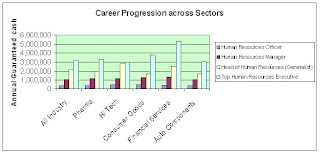
Career Progression Analysis
The career progression in any function is linked to compensation and this section explores the increase in compensation during a career jump within the HR function across sectors. It is seen that the most striking increase in compensation is when one moves from an officer level to a managerial level. This is seen to be true across sectors without exception. Even the degree of increase is seen to be fairly consistent across sectors, with the increase being in the range of 180% (FMCG) to 240% (Pharmaceutical).

The increase noted when there is a progression from Management to Senior Management in HR is less dramatic. This is true for all sectors, without exception. However, it is seen that some sectors downplay this progression, notably the Consumer Goods industry (30%) while some other sectors have more telling hikes in compensation (Financial Services and Pharmaceutical sectors giving 89% and 75% resp).
This trend continues in the progression from the Senior Management level to the Top Management level. Here, the most striking example is the Consumer Goods or FMCG sector, where the sector seems to reward this movement very well, with the increase to the tune of 130%. Other sectors are less striking in their increases, with increases ranging from 63% (Pharmaceuticals) to 109% (Financial Services).

Sub Function Analysis

Different sectors are seen to reward different skill sets within the HR function. Compensation and Benefits specialization in HR is seen to command a slight premium in the market across sectors at the managerial level with sectors like FMCG paying more to a Compensation and Benefits manager as compared to an HR Generalist. This could be in light of Rewards as a philosophy for Attraction and Retention emerging into the limelight. This premium is seen to be almost 33% in sectors like FMCG. Further, even in sectors like IT, this trend is noted, though the premium is not of the magnitude seen in the Consumer Goods space. In this sector, Recruitment as a specialization is seen to command a premium, with Recruitment Managers getting paid differentially. Another observation is that Employee Relations Manager commands a premium in manufacturing sectors like Auto Components industry. A slightly deviant trend is noted in the pharmaceutical industry, where the HR Generalist is paid well above any of the sub function managers.

Variable Pay Analysis
The emphasis on Variable Pay or Pay for performance continues to be paramount, with companies in every sector using this as a tool for attracting and retaining talent. This trend is consistent across sectors; however the extent of variable pay in the annual total remuneration of an incumbent varies widely. A notable example here is the Oil and Gas industry, where the variable pay as a component of total CTC is the highest seen across levels. At the top management level, the sectors which are seen to pay a huge portion of CTC as variable pay are Oil and Gas and Financial Services. This percentage is seen to be as high as 27% in these sectors for the top HR executive. This percentage does not show much variation in any other sector, with values ranging between 20 to 23%. At the junior levels, (HR officer) the chemical industry is seen to pay a higher variable pay portion than any other sector. The FMCG space is seen to be paying a good percentage as variable pay to the senior management and above, with the variable pay at the managerial and officer level falling below that of other sectors.


* Reference Times Ascent